Interview
Rachel Hyein Kim
The Economist, United Kingdom
Rachel Hyein Kim’s creative journey began with a lifelong love of art and evolved into a career focused on design and visual storytelling. Now a designer at The Economist, she draws on diverse experiences across publishing, music, and media to craft engaging visual narratives.
1 Congratulations on your achievements in the NYX Awards! Could you start by introducing yourself or your agency? Can you also share a bit about your journey into your current industry?
My name is Rachel Hyein Kim, and I’m a designer in the Creative Studio team at The Economist. I’ve always been interested in art growing up, from drawing to painting, and that naturally led me toward design. I graduated from the School of Visual Arts in 2020 with a BFA in Design and began my career shortly afterward. Alongside graphic design, I’ve always loved music and motion graphics, and one of my long-term goals is to become an album cover artist. During my early career, I explored different creative disciplines through internships and freelance experiences, including work with Atlantic Records and CNN. Those experiences helped shape the way I approach visual storytelling today.
2 What inspired you to submit your work for this competition, and what does winning mean to you personally and professionally?
Back in college, I always dreamed of winning a design award one day, so this recognition means a great deal to me personally. It’s the first time I’ve received an international award with my name attached to professional work, which makes it especially meaningful. Professionally, it feels rewarding to know that the projects my team and I created have resonated beyond the company and been recognized within the wider creative industry. It’s both encouraging and motivating for future work.
3 Can you share the story behind your success? What inspired its creation, and what do you feel it represents in today’s industry?
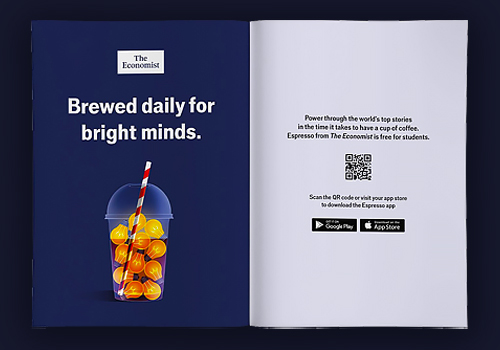
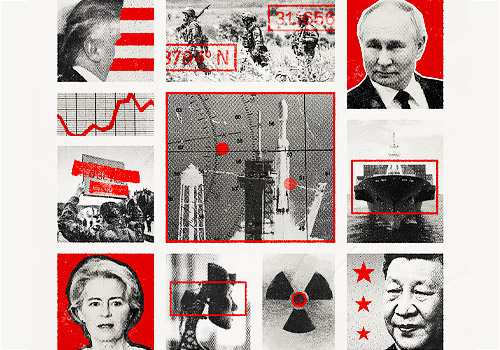
For these projects, I was inspired by the themes and global issues the editorial content was exploring rather than the design direction itself. With Election Campaign 2024, I wanted to capture the political tension, fragmentation, and uncertainty surrounding a major global election cycle, especially the sense that the outcome would have consequences far beyond the US. The disrupted collage system reflected that instability and emotional intensity while still making the information visually engaging and readable. For The World Ahead 2025, the idea was more about navigation through complexity. The campaign explored geopolitics, conflict, technology, AI, and climate, and I wanted the visual system to feel dense and chaotic while still giving audiences a sense of direction. The red graphic interventions were inspired by navigational markings found on maps, reinforcing the idea of The Economist as a guide through uncertainty. I think the work represents a broader shift within the industry, where editorial design is not only about presenting information clearly, but also about creating emotionally resonant and visually distinctive experiences that help audiences connect with complex subjects.
4 What do you believe set your project apart in such a competitive field? Were there specific elements or strategies that made it shine?
One thing our team consistently tries to do is approach campaigns with a strong conceptual foundation while ensuring they stand apart visually from competitors. We wanted the work to feel striking enough to capture attention immediately while still supporting the editorial integrity of The Economist. For example, the fragmented collage system used in Election Campaign 2024 reflected political tension and instability, while the bold graphic interventions in The World Ahead 2025 helped structure complexity into something readable and navigable. I think the balance between strong visual impact and clear conceptual thinking helped the work stand out.
5 Every project has its challenges. Can you share a significant obstacle you faced during this process and how you overcame it?
One of the biggest challenges was the unpredictability of the events themselves—particularly during the election cycle, where developments and candidates could change very quickly. At the same time, we had to remain visually balanced and avoid appearing politically biased by over-emphasizing certain individuals or perspectives. Finding the right imagery was also challenging, especially when trying to create consistency across multiple public figures and visual sources. Through close collaboration with the Creative Director, Art Director, and editorial team, we refined the work carefully through feedback and discussion until the campaigns felt both visually cohesive and editorially appropriate.
6 Winning an award of this caliber often brings recognition. What do you hope this achievement will mean for your career, your team, or your agency in the long run? Have you already noticed any changes or opportunities arising from this recognition?
I hope this achievement brings broader recognition to our Creative Studio team and the type of work we’re producing at The Economist. Internally, it has already been encouraging to see colleagues across the company engage with and celebrate the projects. Personally, I hope it opens opportunities to continue growing creatively, take on more ambitious projects, and connect with a wider creative community. Hopefully, it will also lead to more opportunities like this interview.
7 What has the reaction been from clients, audiences, or stakeholders about your winning entry? Any feedback or memorable moments that stand out?
The response internally has been incredibly positive. Our team received a shoutout during a company-wide meeting, which was a really memorable moment because it felt like the work was being recognized not just creatively, but across the wider organization as well. From a marketing perspective, I also heard that the campaigns performed strongly and connected well with their intended audiences, which was especially rewarding because the goal was always to make complex editorial subjects feel more engaging and accessible through visual storytelling.
8 For those aspiring to achieve similar success, what advice would you offer to help them not only thrive in their industries but also craft compelling, award-worthy entries? Are there specific practices, mindsets, or strategies you believe are key?
I think a few things are especially important: being conceptual, communicating clearly, collaborating well with others, and staying critical of your own work in a healthy way. Strong creative work rarely comes from visuals alone; it comes from having a clear idea behind them. I also think curiosity and ambition matter a lot. Being genuinely excited about making great work pushes you to refine ideas further and pay attention to details people might otherwise overlook.
9 The creative industry is constantly evolving. How do you view these changes, and where do you hope to position yourself in the future?
One of the biggest shifts in the creative industry right now is the development of AI. Personally, I still value the human side of creativity very deeply, particularly the emotional and conceptual thinking that comes from lived experience. At the same time, I think it’s important to understand how new technologies can be adapted and used responsibly within creative practice. Looking ahead, I’d love to continue exploring different areas of design while broadening my work as an artist. I’m especially interested in projects that combine editorial design, music, motion, and visual storytelling.
10 Entering awards can be daunting for many, especially those just starting out. What would you say to individuals who have limited experience, or are hesitant to showcase their work in competitions? How can they build confidence and see the value in participating?
I’d say that awards are not always a perfect measurement of your work or talent. Creative fields are subjective—sometimes people simply respond differently to certain styles or ideas, and sometimes timing or luck also plays a role. The most important question to ask yourself is: “Am I proud of this work?” If the answer is yes, I think that already means something valuable. Competitions can be a great opportunity to build confidence, reflect on your progress, and share your work with a wider audience.
11 Creativity thrives on community. What message would you like to share with fellow creatives, marketers, and advertising professionals?
One lyric that has always stayed with me is from Tender by Blur: “Come on, come on, come on, Get through it, Come on, come on, come on, Love’s the greatest thing.” I think creative work is ultimately about connection—connecting with people, sharing ideas, and making something meaningful that others can feel something from. In such a competitive industry, it’s easy to become overly focused on individual success, but I believe empathy, sincerity, and supporting one another are just as important as ambition.
12 Winning is a team effort in many cases. Is there someone or a group of people you’d like to dedicate this achievement to, and why?
I’d like to dedicate this achievement to the Creative Studio team at The Economist, and especially the people I worked closely with throughout these campaigns. Creative Director: Michael Bradshaw Art Director: Vishaal Mistry Copywriters: Robert Bull, Ryleigh Wann I’d also like to thank Jennifer Parker for helping guide us through the award submission process. These projects were truly collaborative efforts, and I’m very grateful to have worked alongside such talented and thoughtful people. And of course, most importantly, I’d like to thank my family, my mom, my brother, John, and my cat, Ash, for always supporting and encouraging me throughout my creative journey.
13 If you could describe your award-winning entry in one sentence, what would it be and why?
“It’s something unpredictable, but in the end it’s right.” That lyric from Good Riddance (Time of Your Life) by Green Day feels fitting because these projects evolved through uncertainty, experimentation, and constant refinement—but in the end, everything came together in a way that felt meaningful and rewarding.
14 Finally, what’s next for you? Any exciting projects or upcoming goals that you’d like to share with us and the audience?
As part of The Economist’s Creative Brand Studio team, I’m excited to continue creating campaigns that bring editorial ideas to audiences in visually engaging ways, across both editorial and marketing-focused projects. Personally, I’m also looking forward to continuing to grow as an artist and exploring new creative directions in the future.